
A forklift breakdown rarely happens at a convenient time. Whether it’s mid-shift in a distribution centre or during a busy loading window at a warehouse, an unplanned stoppage can quickly ripple through daily operations.
For many NSW businesses, the instinct is to arrange transport and send the forklift away for assessment. But moving equipment off-site for every fault can add extra delay before diagnosis even begins. In many cases, having a technician attend the workplace to inspect and, where appropriate, repair the issue on the spot can help operations resume sooner.
This article looks at how onsite forklift repairs work, what types of issues are commonly checked onsite, and when a workshop visit is the more suitable option.
Why Is Forklift Downtime a Problem for NSW Businesses?
Forklift downtime affects far more than the machine itself. When a forklift is out of action, material handling slows down, loading and dispatch schedules can be pushed back, and other equipment or staff may need to cover the gap.
For warehouses and distribution centres working to tight time windows, even a few hours of lost forklift availability can affect the flow of the entire site. The longer a fault takes to diagnose, the more that disruption tends to build.
How Do On-Site Forklift Repairs Reduce Downtime?
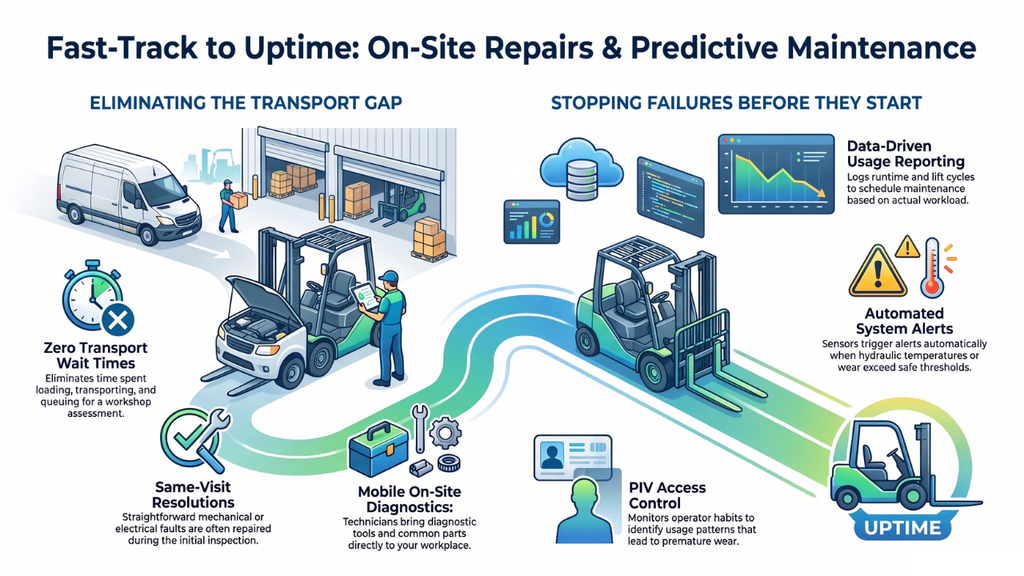
Direct answer: Onsite forklift repairs reduce downtime by allowing a technician to inspect, diagnose and, where suitable, repair the fault at the workplace — avoiding the time otherwise spent arranging transport and waiting for a workshop assessment.
With On-Site Forklift Repairs Newcastle NSW, a mobile technician comes to the site with diagnostic tools and common parts on hand. Rather than the forklift being loaded, transported and queued for inspection elsewhere, the assessment starts as soon as the technician arrives.
For straightforward mechanical or electrical faults, this can mean the forklift is back in service the same visit. For more involved issues, an onsite inspection still gives a clear picture of what’s wrong before deciding on next steps — which is often quicker than waiting for that same diagnosis to happen at a workshop.
What Forklift Problems Can Often Be Checked Onsite?
Not every issue needs a workshop visit for an initial look. Common problems that technicians can often assess onsite include:
- Starting or ignition problems
- Battery charging or connection issues
- Hydraulic leaks or reduced lift performance
- Tyre wear or damage
- Braking concerns
- Steering irregularities
- Unusual noises during operation
- Dashboard warning lights
- LPG-related faults
- Minor mechanical adjustments
This isn’t an exhaustive list, and not every fault in these categories can be fully resolved onsite — but many can at least be properly diagnosed there, which helps determine whether further workshop work is needed.
Faster Fault Diagnosis Can Prevent Further Disruption
It can be tempting to keep a forklift running if it’s “still working,” even with a strange noise, a small leak or a warning light on. In practice, this is often when small problems turn into bigger ones.
A minor hydraulic leak left unchecked, for example, may lead to reduced lift capacity or further internal wear. A warning light ignored for a few shifts could point to an issue that gets more expensive — and more disruptive — the longer it continues.
Early fault diagnosis gives businesses the chance to address a problem while it’s still manageable, rather than after it’s caused a full breakdown.
On-Site Repairs Can Reduce Transport and Handling Delays
Transporting a forklift to a workshop involves more than just distance. There’s arranging suitable transport, safely loading the machine, and often waiting in a queue once it arrives.
Where a fault can be safely diagnosed and repaired at the site, this transport step is avoided altogether. That can matter a lot for businesses running tight schedules, where every hour without a forklift has a knock-on effect on other tasks.
Of course, not every repair is suitable for onsite work — some require workshop equipment or controlled conditions. But where it is suitable, cutting out the transport stage is one of the more practical ways to limit extended downtime.
Regular Servicing Can Help Prevent Unexpected Breakdowns
Reactive repairs matter, but a lot of unplanned downtime can be reduced through consistent servicing. Regular inspections give a technician the chance to spot wear on tyres, hydraulic components, brakes or batteries before they become a mid-shift failure.
Servicing intervals can vary depending on the forklift type, manufacturer recommendations, hours of use and the conditions the equipment operates in — a forklift running multiple shifts on a rough outdoor yard will generally need closer attention than one used occasionally indoors.
Businesses looking for ongoing Forklift Service & Support Newcastle often find that scheduled servicing, paired with prompt attention to any faults that do arise, is a practical way to keep equipment more reliable over time.
When Should You Request Forklift Assistance?
Direct answer: A forklift should be taken out of service and inspected when there are unusual noises, visible fluid leaks, steering or braking changes, starting difficulties, reduced lifting performance, active warning indicators, or any fault that keeps recurring.
Continuing to operate a forklift showing these signs can increase the risk of the problem worsening — and potentially turning a same-day fix into a longer repair. If your team notices any of these warning signs, it’s worth arranging Forklift Assistance in Newcastle sooner rather than later, so the issue can be properly assessed.
Can Every Forklift Repair Be Completed Onsite?
Direct answer: No. Many faults can be diagnosed and repaired onsite, but some issues — such as major component failures, internal transmission or engine work, or repairs needing specialist workshop equipment — may require the forklift to be taken to a workshop.
This is an important point for any business relying on forklift equipment: onsite repairs are a genuinely useful option for a wide range of common faults, but they’re not a substitute for workshop facilities when a repair calls for them. A proper onsite inspection is often what determines which path is needed.
How Can Businesses Reduce Future Forklift Downtime?
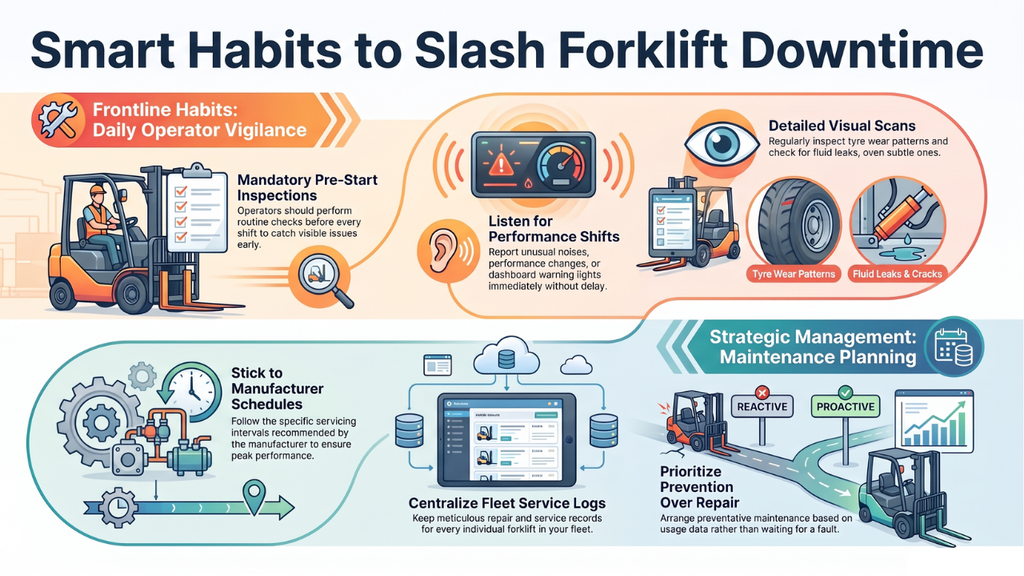
A few practical habits can lower the chances of unexpected breakdowns:
- Follow manufacturer-recommended servicing schedules
- Encourage operators to do routine pre-start checks
- Report unusual noises or performance changes early
- Keep an eye on tyre condition and wear patterns
- Check for fluid leaks regularly, not just when they’re obvious
- Don’t ignore dashboard warning lights
- Keep service and repair records for each forklift
- Arrange preventative maintenance rather than waiting for a fault
None of these guarantee a fault-free forklift, but together they reduce the likelihood of a small issue turning into a full breakdown at the worst possible time.
Frequently Asked Questions
Q1. What is an on-site forklift repair?
An onsite forklift repair is when a technician attends the workplace to inspect, diagnose and, where possible, repair a forklift fault directly at the site, rather than the equipment being transported to a workshop.
Q2. How quickly should a forklift fault be inspected?
Any fault affecting safety, steering, braking, lifting performance or unusual noises should be inspected as soon as practical, rather than continuing to operate the equipment until it worsens.
Q3. Can all forklift breakdowns be repaired onsite?
No. Many common faults can be diagnosed or repaired onsite, but some issues involving major components or specialist equipment may need a workshop.
Q4. What are common warning signs that a forklift needs repair?
Warning signs include unusual noises, fluid leaks, steering or braking changes, starting problems, reduced lifting capacity and active warning lights.
Q5. How does preventative servicing reduce forklift downtime?
Regular servicing helps identify wear on parts like tyres, brakes, batteries and hydraulic systems before they lead to an unplanned breakdown.
Final Thoughts
Forklift breakdowns are disruptive, but how they’re handled makes a real difference to how long that disruption lasts. Timely onsite diagnosis — and repairs where they’re suitable — can help NSW businesses get equipment back in action without the added delay of unnecessary transport.
If your forklift is showing warning signs, or you’d like to arrange regular servicing to stay ahead of unexpected faults, Our Town Forklift Service Pty Ltd can help assess what’s needed for your site. Businesses across Newcastle and the surrounding NSW area experiencing forklift issues are welcome to get in touch with OTFS to arrange an inspection or discuss suitable service support.